
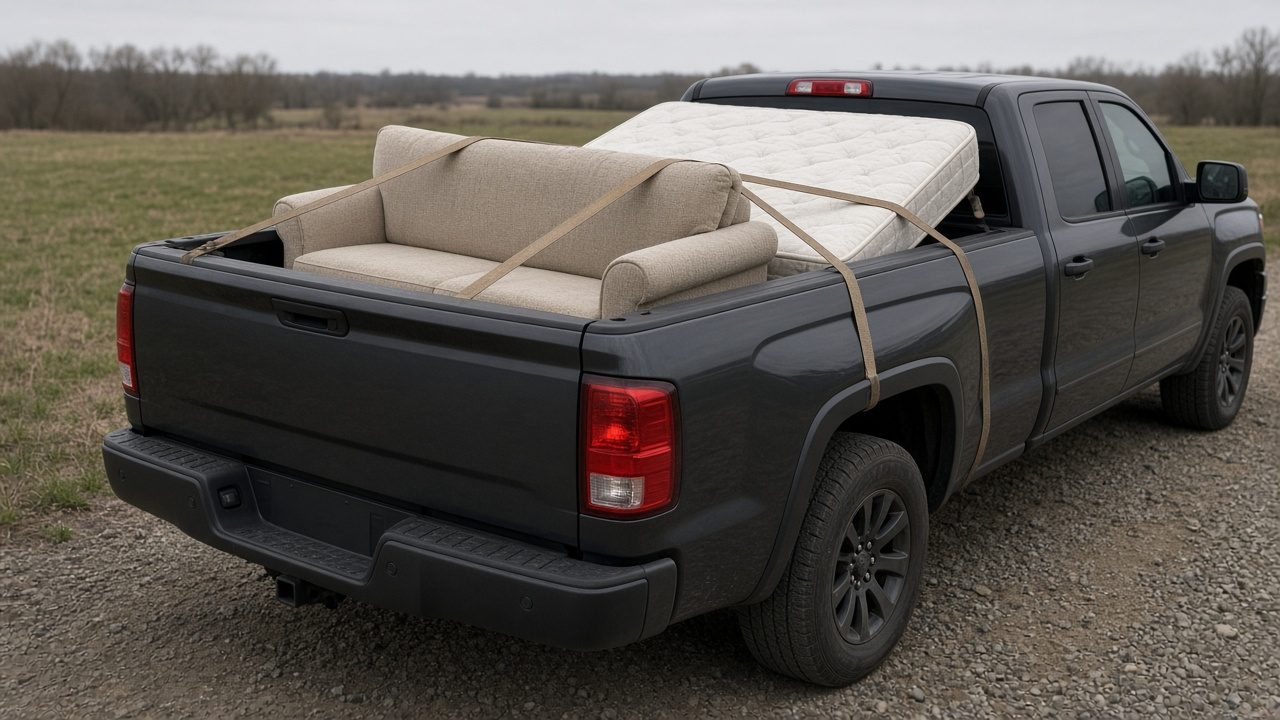
A junk removal page should list what you take and what you decline, in words the person booking can repeat, so the truck goes only to a load you have already agreed to haul. A page that shows the work and hides the limits will book the wrong job. The page, the booking note, and the load on the truck have to describe the same job before you promote a pickup.
This guide covers what the page has to accept, what it has to decline, what the booking note repeats, which photos cause the wrong job, how to check the page against loads you refused, and how the junk removal page and this article split the work.
Takeaways
- Put the loads you accept and the loads you decline on the page in plain language.
- Make the booking note repeat those same lines before a truck is assigned.
- Remove or relabel photos that depict a job you would refuse at the curb.
- Check the page against loads you recently refused, and fix the line that let them through.
What the Page Has to Accept
The page has to accept, in writing, the loads your truck already takes on a normal day. Name them the way your crew does: household furniture, bagged goods, the appliances you already haul, and the cleanout of a room or a garage when that is work you do. A visitor should recognize their own load, or see plainly that it is not on the list.
Acceptance has to be specific. "We take junk" accepts everything and decides nothing. Group the yeses so a person can match a pile without calling first, and say what a load means in your shop. If you take a garage but not a whole house, say so. If you take items at the curb but not items someone must carry down from an attic, say that too. Every yes is also a boundary.
Write the yes in the same tone you use when you are glad to roll. Short lines beat a paragraph of enthusiasm. If a sentence could describe a company that takes a different mix, rewrite it until it could only describe yours. Your crew should be able to read the accept list and nod without adding a quiet exception.
Leave off work you only take as a favor. A favor that appears on the page becomes the offer, the next caller will expect it, and the dispatcher will either scramble or look inconsistent. Favors stay off the page until they become loads you are willing to repeat.
What the Page Has to Decline
The page has to decline the loads you already refuse, in language as visible as the accept list. Burying the no in a footer, or saving it for the curb, is how the truck gets sent. A visitor who never sees the no will book in good faith, and the refusal then feels like your change of mind instead of a rule you published.
Decline by category, not with a vague warning. Name the kinds of items your crew does not put on the truck, the loads that belong to a different trade, and the situations you will not walk into, such as a pile you cannot see before you roll. You do not need a speech about why. You need a line the booker can point to.
If a load is sometimes a yes, do not list it as a flat yes or a flat no. Say what must be true: the item is already at the curb, the pile is the kind you photograph and approve, or a person has to call before a truck is set. Sometimes without a rule is a guessing game, and the guess will be optimistic.
Put the decline where the booking starts. A schedule button sitting above a list that never mentions a no will collect the wrong jobs. The decline is part of the offer. A page that only celebrates what you take advertises a broader company than the one that shows up.
Where safety is involved, be blunt. If a pile may hold something hazardous, or a path is unsafe for your crew, the page should say you will not roll until that is sorted out, and it should point the person to the right local disposal channel instead of leaving them guessing.
What the Booking Note Repeats
The booking note repeats the accept line, the decline line, and the limit that decided this job. It is not a second brochure. It is the sentence the driver carries. If the note holds only an address and a time, the page's careful list never left the website.
The note should name what the customer said they have, in the same categories as the page. It should name what they were told you will not take. It should also record anything that still has to be true on arrival, such as the pile being visible or the path being clear enough for the crew you send. A note that says junk removal repeats nothing.
When a photo was used to judge the load, the note should say what the photo was understood to show, and that a different pile is a different job. People add to a pile after they send a picture. The note is how the driver knows the picture was the agreement. Without it, the curb becomes a negotiation the page already tried to prevent.
Read the note back to the customer before the truck is assigned and ask them to correct the categories. A correction caught on the phone saves the drive. A correction caught at the curb wastes it, and it leaves the driver enforcing a rule the customer says they never heard.
Photos That Cause the Wrong Job
Photos cause the wrong job when they show a load you would not take, or a load much larger or smaller than the one you mean to book. Visitors trust a picture more than the paragraph beside it, so if the two disagree, the picture wins.
| What the photo shows | What the visitor concludes | What the page should do |
|---|---|---|
| A tidy pile of furniture you do take | This is the kind of job you want | Keep it, and caption it with the accept line |
| A whole property or a construction pile you do not take | You will clear anything | Remove it, or label it as work you do not book |
| A mixed pile with items you refuse | The refused items are included | Crop or replace it, and repeat the decline in the caption |
| A crew in a tight interior you do not carry from | You will empty any room from the inside | Use a photo of the arrival you actually offer |
| A before-and-after with no sense of the load | Any size of job looks the same | Pair it with the limit that decides whether you roll |
Do not keep a dramatic photo because it looks busy. Busy is not a category. If you cannot caption the photo with a load you accept, the photo is booking a different company. Replace it with a picture of a job your driver would recognize as a normal yes.
Check the images in the form, the gallery, and any confirmation message. A declined load can reappear in a small picture long after you rewrote the paragraph, and the truck follows the picture the customer remembers.
How to Check the Page Against Refused Loads
Check the page against loads you refused while the reason is still clear. You are hunting for the sentence or the photo that made the customer think the truck was coming.
- Pull a handful of recent refusals, including ones caught on the phone and ones caught at the curb.
- For each, write the customer's words for the load next to the page line they likely trusted.
- Mark whether the page accepted that load, declined it too quietly, or showed it in a photo.
- Rewrite the accept or decline line so the refusal would have been obvious before booking.
- Change the booking note so the same line is read back on the next similar call.
- Look again after the next few bookings, and keep any refusal that still surprises you on the list to fix.
Do not treat a curb refusal as a one-time customer problem if the page invited it. The driver did the right thing by not hauling a load you do not take. The page's job is to make that refusal happen earlier, in writing, before anyone has rolled. If the same category keeps appearing, it is not a string of odd calls. It is a missing no.
Share the revised lines with whoever answers the phone the same day you change the page. A new decline that lives only on the site will be overruled by an old script.
How the Junk Removal Page and This Article Split the Job
The Junk Removal page is the offer. It should list what you take, what you decline, and what the next step is, in the same words as the booking note. This article does not replace that page. It teaches the decision: publish the load so the truck is not sent for a job you will refuse.
Moving & Storage is the wider trade. A junk page that sounds like a full move, or a move page that quietly offers hauling you do not do, will book the wrong truck. If you do both, say which next step belongs to which offer. Triwave Consulting looks at that agreement first. The page, the next step, and the loads you haul have to match before any promotion.
The order of work is Initial Contact, then Detailed Discussion, then Implementation. Here, Initial Contact is the accept list and the decline list. The Detailed Discussion is the booking note that repeats them. Implementation is the page, the photos, and the form using those same lines. If the truck is still rolling for surprises, fix the agreement before you try to book more stops.
Questions
Should the Decline List Be as Easy to See as What You Take?
Yes. If a visitor can book from the accept list without passing the decline list, the decline list is decoration. Put the no where the yes is, in language a person can read at the same speed. A quieter no is still hidden, and the customer who needed it will not hunt for it, so your driver ends up delivering the refusal.
What If a Caller Describes a Load You Only Sometimes Take?
Do not book it from the accept list. Use the rule you wrote for the sometimes case, or make one before you answer. If the rule is that you need a photo or a clearer description first, say that and wait. If you have no rule, the honest answer is that you need to decide the category before a truck is promised. A one-time yes, spoken on a busy call, becomes the next person's expectation.
How Detailed Should the Booking Note Be?
Detailed enough that the driver can see the category, the limit, and what was declined without calling you from the curb. It does not need a story. It needs the same nouns as the page. If the note could fit any junk job in your week, it is not detailed enough to prevent the wrong load.
What Should You Do With a Photo of a Mixed Load?
Do not book the whole photo as a yes. Name the items in the picture you will take and the items you will not, and ask the customer to confirm. If the refused items are the bulk of the pile, decline the job or say what has to change before you roll. A mixed photo booked as junk is a curb argument you already had the picture to prevent.
When Should the Truck Wait for a Call Back?
Wait when the load falls in a sometimes category, when the photo and the description disagree, or when the customer has not heard the decline list. Rolling to discover the load is the expensive way to read your own page. A short call that repeats the note is the better next step, and the truck gets assigned once the note matches a load you accept.
Conclusion
List what you take and what you decline, and make the booking note repeat both before a truck is sent. Photos have to show the same loads. The page, the next step, and the work on the truck have to describe one job, or you will keep driving to the wrong pile.
To line up the junk removal page, the booking note, and the loads the truck actually takes, Speak With Us.